Automation is evolving fast, moving from single-task systems to interconnected networks of smart AI. These innovations promise to change how businesses tackle complex problems, blending efficiency with adaptability. But with greater potential comes greater challenges. How can companies harness this progress while navigating its risks?
How AI Agents Differ From Agentic AI: What Businesses Need To Know, featured on Forbes, examines the distinctions between two advanced AI models reshaping automation: AI agents and agentic AI. While both go beyond traditional generative AI systems, they differ notably in scope and implications. AI agents are individual systems designed to autonomously execute specific tasks using tools like APIs and databases. These agents perform well in structured environments such as customer service, scheduling, and knowledge retrieval, relying on planning and iteration to accomplish preset goals. In comparison, agentic AI introduces multi-agent ecosystems, where several specialized agents collaborate in a guided manner to handle sophisticated tasks. This coordination allows for contextual understanding, adaptive responses, and simultaneous task execution, making it particularly useful for complex environments like supply chain optimization or layered research projects.
AI agents demonstrate value by improving efficiency in areas like customer support and enterprise search, with measurable results. On the other hand, agentic AI brings features such as contextual memory and inter-agent collaboration. For instance, in a research environment, multiple agents can collectively produce high-quality outputs like grant proposals much faster than before, showcasing their ability to address more complex challenges. However, as both approaches develop, they must grapple with pressing concerns such as hallucinations in AI agents and coordination issues within agentic systems, which could complicate their practical use.
Why It Matters
These developments represent a shift in the AI field, offering more than just reactive language models. Businesses are realizing that AI agents can autonomously achieve meaningful, outcome-oriented objectives rather than solely responding to queries. The rise of agentic AI pushes this idea further, creating possibilities in research automation, robotics, and logistics where collaborative problem-solving between AI systems can occur with a more refined understanding of challenges. As these systems improve, they could influence how organizations structure their workflows, allocate resources, and achieve outcomes.
Advantages
AI agents and agentic AI provide clear advantages for businesses looking to improve efficiency. AI agents already show how automation can save time and enhance accuracy in everyday tasks. Recent studies highlight how these systems have reduced customer service response times by over 40% and increased knowledge search accuracy by 29%. Meanwhile, agentic AI builds on these benefits by addressing intricate, interconnected processes requiring innovation and long-term planning. By coordinating multiple agents specializing in specific tasks, businesses can accelerate projects such as critical documentation or detailed planning processes with improved accuracy.
Challenges
Though promising, these systems are not without limitations. Current AI agents sometimes produce inaccurate or misleading outputs, particularly when initial instructions are ambiguous. Agentic AI, despite its potential, introduces additional complexities related to synchronizing multiple systems reliably. Coordination failures, limited transparency in decision-making, and unpredictable behaviors could hinder adoption if not resolved. Both systems will need ongoing refinements to address these obstacles effectively.
Potential Business Applications
- A startup offering a research assistant platform, where agentic AI helps combine academic or corporate findings into comprehensive, ready-to-use reports.
- An AI-powered logistics platform that aligns shipping, inventory, and supplier communication using agentic AI orchestration.
- An agency leveraging AI agents to automate campaign tasks, such as generating ad copy, scheduling social media, and optimizing strategies based on performance metrics.
The progress in AI agents and agentic AI signifies a pivotal stage in automation’s role across industries. While these technologies offer great promise, there are also critical challenges that require careful attention, particularly as systems grow more intricate and self-reliant. Businesses that actively explore and implement these advancements can enhance operations and redefine productivity across many areas. However, ensuring a balance between maximizing efficiency and managing risks will shape how impactful these technologies ultimately prove to be.
—
You can read the original article here.
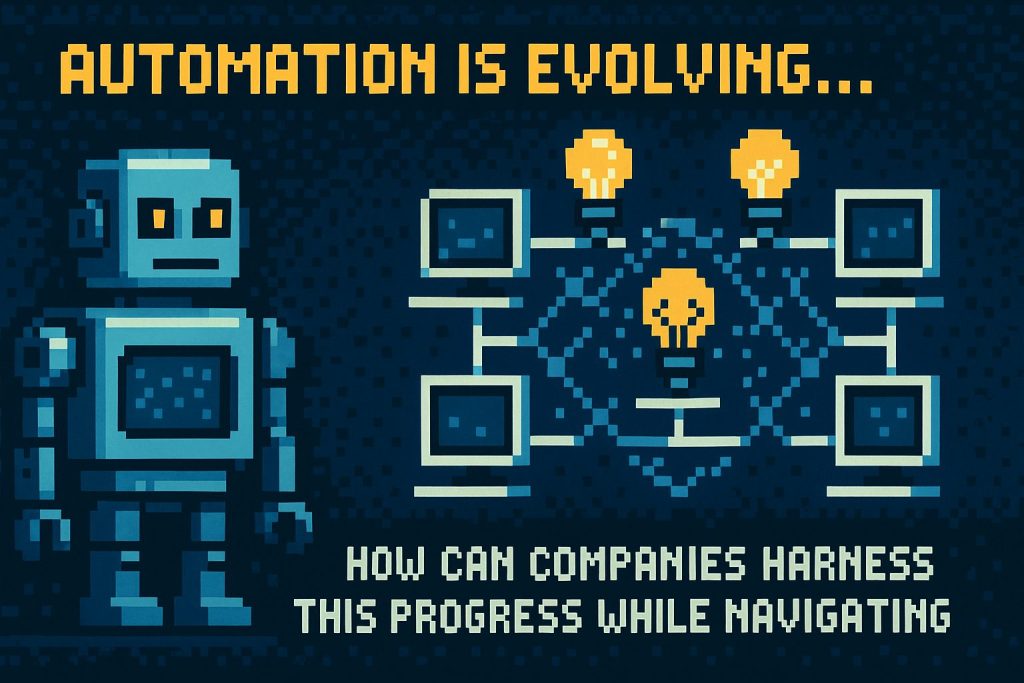
Image Credit: DALL-E 3 / 8-Bit Art. Make a custom style AI image HERE!
—
Want to get the RAIZOR Report with all the latest AI news, tools, and jobs? We even have a daily mini-podcast version for all the news in less than 5 minutes! You can subscribe here.
RAIZOR helps our clients cut costs, save time, and boost revenue with custom AI automations. Book an Exploration Call if you’d like to learn more about how we can help you grow your business.