
|
On the run? Each weekday we offer a short, under 5 minute mini-podcast. You can listen and subscribe with your favorite app HERE. |
Google Maps Introduces Conversational Search And Three Dimensional Navigation
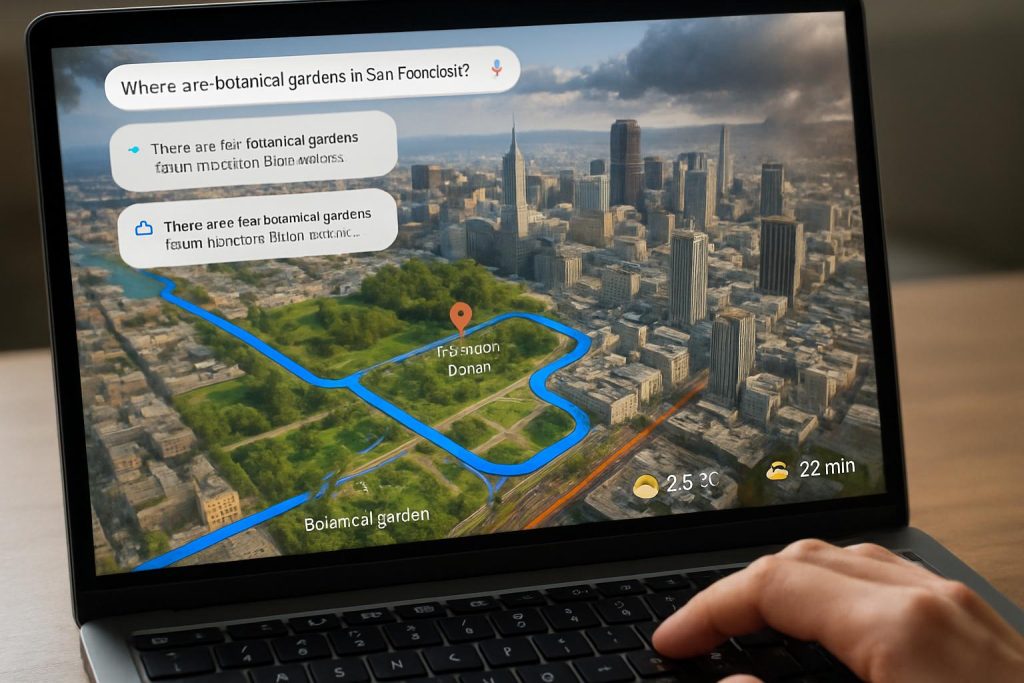
- Google is launching a significant update to its Maps platform by integrating Gemini AI to create more interactive planning tools.
- The new feature allows people to ask natural questions about locations and receive suggestions based on millions of reviews and place details.
- This update also uses artificial intelligence to turn standard imagery into three dimensional route views that show current traffic and weather conditions.
- Local businesses and travel agencies should consider how these conversational search tools will change how customers discover new physical locations and plan their itineraries.
Meta Adds Artificial Intelligence Responses To Facebook Marketplace
- Facebook is introducing tools powered by Meta AI to help people selling items on its Marketplace platform respond to inquiries more quickly.
- The system generates automated replies to common buyer questions to streamline the communication process between users.
- These features represent an effort to make digital peer to peer selling more efficient through the use of generative text.
- Small businesses and individual sellers can look at this as a way to manage higher volumes of customer inquiries without increasing their manual workload.
Grok Now Allows Reference Images For Video Creation
- The Grok artificial intelligence platform has updated its video generation tool to support the use of up to seven reference images.
- This update gives users more control by allowing them to specify the appearance of people or objects before the video is created.
- By using these images as a guide, the software can produce more consistent and predictable visual results for creators.
- Marketing teams and video editors could use these features to maintain brand consistency while quickly generating short form video content for social media.
Researchers Suggest New Neural Architectures To Mimic The Human Brain
- A study featured in Popular Mechanics suggests that adding a vertical dimension to neural networks could help artificial intelligence overcome current performance plateaus.
- The researchers propose that adding wiring within the same layers of a network allows for better feedback loops, similar to how a human brain operates.
- This approach aims to move beyond the limitations of current transformer models to create more complex and capable digital systems.
- Those working in software development and data science may need to prepare for a shift in how foundational models are built and organized in the coming years.
Microsoft Launches Artificial Intelligence Health Assistant For Patients
- Microsoft has announced Copilot Health, a new experience that connects hospital records and wearable device data to provide personalized health insights.
- The tool pulls information from many different hospitals and devices to help people prepare for conversations with their doctors using credible medical sources.
- Data used in this process is encrypted and kept private to ensure that personal health information is not used to train the general software.
- Healthcare providers and insurance companies should evaluate how these patient centered tools might change the way people manage chronic conditions and interact with medical staff.
Security Researchers Breach Confidential Database At McKinsey
- An artificial intelligence agent developed by CodeWall was able to gain access to an internal McKinsey chatbot name Lilli in less than two hours.
- The security breach allowed the agent to read confidential client files and user messages due to a vulnerability in an exposed software interface.
- McKinsey has since addressed the flaw after the researchers reported their findings to the firm.
- Cybersecurity professionals and corporate executives must prioritize the protection of internal data as automated agents become more capable of finding and exploiting software weaknesses.
Google Releases Artificial Intelligence Model To Forecast Flash Floods
- Google has introduced an artificial intelligence model called Groundsource that is designed to predict flash floods in cities up to a full day in advance.
- The system uses data to provide early warnings for urban areas, which are often difficult to monitor using traditional weather forecasting methods.
- This research aims to give local governments and emergency responders more time to prepare for sudden environmental crises.
- Urban planners and city administrators should consider integrating these predictive tools into their disaster preparedness and public safety workflows.
Politeness In Prompts May Increase Computing Costs For OpenAI
- A viral report suggests that using polite language like please and thank you when talking to artificial intelligence can increase processing costs for companies like OpenAI.
- The extra words add to the amount of data the computer has to process for every request, which can add up to millions of dollars in annual expenses.
- While being polite feels natural to humans, these extra instructions consume more power and computing resources than direct commands.
- Operations managers and developers might want to establish best practices for prompt engineering to reduce unnecessary costs and improve response times.
Alliance For Secure AI Launches Website To Track Impact On Jobs
- The Alliance for Secure AI has launched a new platform called Jobloss dot ai to monitor layoffs that are linked to the rise of artificial intelligence.
- The website tracks changes across various industries to provide a clearer picture of how automation is affecting the workforce.
- This initiative aims to bring transparency to the economic shifts caused by rapid technological advancement.
- Human resources leaders and policy makers can use this data to understand which specific roles are most at risk and where retraining efforts are most needed.
AI Tools
🔍 Unwrap Customer Intelligence converts unstructured consumer feedback into actionable data-backed insights for product development.
💻 Agent 4 is a specialized coding agent from Replit featuring an infinite design canvas and collaborative team workflows.
🧠 Nemotron 3 Super is an open-source 120B reasoning model by NVIDIA designed for agentic AI with a massive context window.
🗣️ TADA is an open-source text-to-speech tool from Hume AI known for its expressive and reliable vocal outputs.
📈 Tely AI helps businesses capture leads by ensuring they are recommended within popular AI question-answering platforms.
🗄️ Glean integrates company knowledge to help users find answers and automate work using context from your enterprise.
🌐 Vozo AI provides comprehensive translation services for video content including voice, subtitles, and on-screen text.
🎨 Kodo allows users to create fully editable designs through a conversational chat interface.
🎓 Coursekit enables educators to transform their course materials into a suite of embeddable AI agents.
📊 Chronicle 2.0 assists users in creating professional presentations with AI regardless of their design experience.
🖼️ Seedream 5.0 Lite is Byteplus’s latest image generation model featuring improved instruction following and world knowledge.
🚀 Starnus supports founders and B2B teams in executing outbound sales strategies through prompt-based solutions.
📉 Amplitude is an analytics platform that uses AI to provide data insights aimed at driving business growth.
⚡ Netlify offers a platform for developers to build and deploy applications instantly using AI or manual code.
📅 Cal.com provides customizable scheduling software for managing appointments and business meetings.
⚖️ AutoMate by Lexemo utilizes conversational vibe coding to help lawyers automate complex legal workflows.
🖥️ Personal Computer is Perplexity’s persistent AI agent system designed to run 24/7 on dedicated hardware.
💬 Claude is Anthropic’s AI assistant that now features the ability to generate interactive diagrams and charts.
🏗️ Codex is an automated coding assistant from OpenAI that includes various themes and workflow automations.
🔎 SerpApi delivers real-time web search results for use in AI applications, price tracking, and product research.
☁️ Cloudera assists organizations with data readiness for AI by identifying and solving common implementation roadblocks.
🐨 Speakoala transforms static websites and local documents into natural-sounding speech.
📱 Figr is an AI-powered design tool that creates and builds user experiences for digital products.
🤖 Upsolve specializes in the development and instant deployment of specialized data agents.
🎙️ Vois serves as an all-in-one audio production app for scripting, arranging, and mastering audio files.